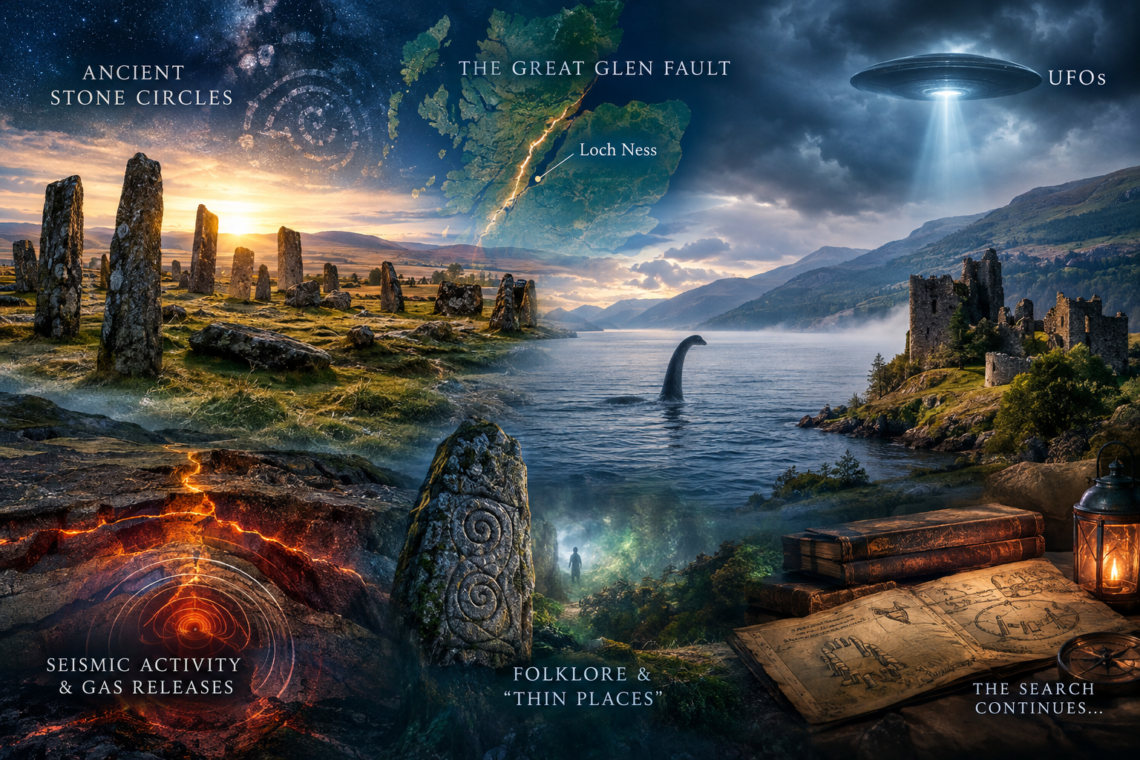
For as long as I can remember, I’ve been fascinated by Scotland’s ancient stone circles, castles, keeps, abbies, and other monuments, standing tall or in ruins. Although I’ve never had the opportunity to visit them in person, I’ve spent countless hours studying photographs, maps, archaeological reports, and local folklore. What began as an interest in prehistoric sites eventually led me down an unexpected path connecting geology, UFO reports, and even the legend of the Loch Ness Monster.
Discovering Scotland’s Stone Circles
My fascination began with Scotland’s ancient stone circles, particularly the recumbent stone circles of northeast Scotland. Sites such as Easter Aquhorthies, Sunhoney, Tomnaverie, and many lesser-known circles scattered across Aberdeenshire have captivated researchers and visitors for generations.
Built thousands of years ago, these monuments continue to raise questions. Why were they constructed in these locations? What purpose did they serve? Were they ceremonial sites, astronomical markers, burial places, or something else entirely? The uncertainty surrounding their origins only deepened my interest.
As I researched more sites and mapped their locations, I began noticing patterns in the landscape that eventually led me in an entirely different direction.
The Geological Connection
That curiosity led me to Scotland’s geology, particularly its ancient fault systems. The most famous of these is the Great Glen Fault, which runs through the Highlands and beneath Loch Ness.
While Scotland is not known for major earthquakes, the fault remains geologically significant and has produced seismic activity throughout recorded history.
This raised an interesting question: could geological processes have influenced local legends, traditions, or even the placement of ancient monuments?
Some researchers have suggested that fault zones can produce unusual phenomena, including earth tremors, strange sounds, ground movement, and, in some cases, electromagnetic anomalies. Whether ancient people understood the causes is impossible to know, but they may have recognized certain locations as unusual or significant.
The Loch Ness Rabbit Hole
The Great Glen Fault brought me to Loch Ness, where geology and legend intersect in fascinating ways.
Among the many theories surrounding Nessie is the suggestion that some sightings may have been influenced by natural geological processes. Underwater disturbances, gas releases, and seismic activity have all been proposed as explanations for unusual movements observed on the loch.
While these ideas remain speculative, they highlight how natural events can become woven into local folklore and enduring legends.
The more I researched Loch Ness, the more I realized that its mystery extends beyond the question of whether a creature exists beneath the surface.
UFOs and Fault Lines
The next step down the rabbit hole came through reports linking UFO sightings to fault zones and areas of geological activity.
Some researchers have proposed that electromagnetic effects associated with seismic regions may contribute to unusual visual phenomena. Others have noted that reports of unexplained aerial activity sometimes cluster near fault systems. These ideas remain controversial and lack broad scientific acceptance, but they add another layer to the discussion surrounding unusual landscapes.
What caught my attention was not necessarily the conclusions, but the recurring appearance of the same locations in different types of mysteries. Ancient monuments, unusual geological features, folklore, and reports of unexplained phenomena often seemed to occupy the same landscapes.
Whether that overlap is meaningful or merely coincidence remains open to interpretation.
Could Ancient Builders Have Known?
One question continued to surface throughout my research: did the builders of Scotland’s stone circles deliberately choose locations that possessed unusual natural characteristics?
Ancient people spent generations observing their surroundings. They understood seasonal cycles, celestial movements, weather patterns, and the landscape itself far better than many of us do today. It is not unreasonable to wonder whether they recognized certain places as special long before modern geology could explain why.
Of course, archaeologists generally interpret stone circles through cultural, ceremonial, and sometimes astronomical frameworks.
Alternative theories involving earth energies, fault lines, and unexplained phenomena remain speculative. Nevertheless, the possibility that natural features influenced site selection is an intriguing one.
Thin Places, Legends, and the Fifth Dimension
My research eventually led into folklore, where Scotland offers no shortage of mysteries.
Across Celtic traditions, stories describe “thin places” where the boundary between worlds is believed to be less distinct. Long before modern discussions of UFOs or alternate dimensions, such locations were associated with unusual experiences, sacred landscapes, and encounters with the unknown that inspire awe.
Modern theories sometimes connect these traditions with stone circles, fault zones, and reports of unexplained phenomena. Some have even suggested that geological activity could somehow create temporary gateways or openings into other dimensions.
There is no scientific evidence supporting such claims, but the persistence of these ideas demonstrates humanity’s enduring desire to understand the unknown.
What I Think
I do not claim to have discovered a hidden connection between stone circles, UFOs, seismic activity, and the Loch Ness Monster. What fascinates me is how often these subjects intersect.
The same landscapes that inspired ancient builders continue to inspire legends. Geological features influence folklore. Folklore influences modern mystery. Each layer builds upon those that came before it.
Whether the connection is physical, cultural, psychological, or simply coincidental, the overlap is difficult to ignore.
And for those willing to follow the trail, Scotland offers no shortage of mysteries waiting to be explored.
Day Trip 1: Inverurie / Garioch / Insch Cluster
- Balquhain, Chapel of Garioch
- Easter Aquhorthies, Inverurie
- Hatton of Ardoyne, Oyne
- Kirkton of Bourtie, Bourtie
- Loanhead of Daviot, Daviot
- Old Rayne, Rayne
- Druidstone, Premnay
- Candle Hill, Insch
- Stonehead, Insch
- Ardlair, Kennethmont
- Tillyfourie (Whitehill), Monymusk
- Nether Coullie, Monymusk
- Optional: Tyrebagger, Dyce (if approaching from Aberdeen)
Base: Inverurie
Driving: Most sites within 30–40 minutes of each other.
- Aikey Brae, Old Deer — ruin – recumbent stone circle in abershire.
- Aquhorthies, Banchory-Devenick — good
- Ardlair, Kennethmont — ruin
- Auchlee, Banchory-Devenick — ruin
- Balquhain, Chapel of Garioch — ruin
- Berrybrae, Lonmay — ruin
- Blue Cairn of Ladieswell, Logie Coldstone — ruin
- Candle Hill, Insch — ruin
- Castle Fraser, Cluny — good
- The Cloch, Benholm — uncertain
- Clune Wood, Durris — ruin
- Corrie Cairn, Tullynessle and Forbes — uncertain
- Corrydown, Auchterless — ruin
- Cothiemuir Wood, Keig — ruin
Druidstone, Premnay — ruin
Easter Aquhorthies, Inverurie — good
Eslie the Greater, Banchory-Ternan — ruin
Hatton of Ardoyne, Oyne — good
Kirkton of Bourtie, Bourtie — ruin
Loanhead of Daviot, Daviot — good
Loudon Wood, Old Deer — ruin
Mains of Hatton, Auchterless — ruin
Midmar Kirk, Midmar — OK (restored)
Netherton of Logie, Crimond — ruin
The Nine Stanes (Garrol Wood), Banchory-Ternan — ruin
North Strone, Alford — good
Old Keig, Keig — ruin
Old Kirk of Tough, Cluny — ruin
Old Rayne, Rayne — ruin
Pitglassie, Auchterless — ruin
Rothiemay, Rothiemay (Moray council area) — ruin
South Fornet, Skene — ruin
Stonehead, Insch — ruin
Strichen House, Strichen — OK (fully reconstructed)
Sunhoney, Midmar — good
Tillyfourie (Whitehill), Monymusk — ruin
Tomnagorn, Midmar — ruin
Tomnaverie, Coull — OK (restored)
Tyrebagger, Dyce — good
Wester Echt, Echt — ruin
Yonder Bognie, Forgue — ruin
Hillhead, Tarland — one stone survives (later addition)
Nether Coullie, Monymusk — one stone survives (later addition, reclassified 2015)